The PENguin Blog


The PENguin's Lament

Confession: I miss the blog. I miss doing stuff and then coming back, analysing, discussing and sharing; and then, on occasion, hearing back from someone about their response.

Don't get me wrong I also miss England, Germany, friends and travel. But I miss the blog.

So, at the risk of posting totally banal, really bloggy -"today my cat caught a bird "- sort of stuff I'm gonna try to post something of interest to someone somewhere each week (more often if possible). It may not always be either travel or pen related but I will try to do it at least once a week and make it as interesting as my humble existence permits. So here goes.

As always, let me know how I'm doing. E-mail works best, but I do check for comments.

Monday, March 30, 2009

The Köln penshow

Ahhh, Germany

Apologies for the silence, but this has been an exciting few days. Last night at dinner with Knut Dorn, the Director of Sales and Operations for Otto Harrassowitz, and his wife Renata, I explained my appreciation for Germany, which came not only from my love of German craftsmanship, but the friendship of Dr. Ekkehard Jecht in the 1970s. But I get ahead of my story . . .

For us, the Köln penshow began Friday morning with a meeting at our hotel in Neuss with Gerhard Brandl, whom I last saw at his home in Regensburg and then at the penshow in Munich almost four years ago. We also remembered Gerhard Baur, who organised that show. Gerhard and I caught up on things and, as it is with those such as us, some pens changed hands. Gerhard has been a great friend to me and it was wonderful to see him.

Later that day, Sharon and I visited with Jürgen Kuhse, his mother Hannalore and another pen friend. Once again, stories were told, pens changed hands and we caught up with one another. It was great to meet Jürgen’s wife Marina and to see their newly remodeled home. They were about to be married when last we visited in the summer of 2005.

After a brief rest at our hotel in central Köln, we all met for the traditional pre-show dinner at the Hotel Falderhof, owned by Christian Zeumer-Peer, who is himself a pen collector. It was great fun to be included in such a festive and traditional gathering.

The show itself was great. There are many differences between American and European penshows. The latter tend to be smaller in size and briefer. But the commonalities are probably greater, the sense of anticipation, the rush to see pens, the community and the sharing.

The show began at 10:00, although some people were earlier and had begun setting up. The site is the Rüder and Tennisclub Germania, which looks out over the Rhein River. It is a nice setting, surrounded by a park and some residences and with a very pleasant bar and restaurant directly adjacent. Most people tend to feel, however, that the room is a bit too small and certainly the atmosphere is intense the tables are very close, the aisles between them small. After only an hour or so, I got rid of my jacket. As the room and the show heated up, literally and metaphorically. When the show opened to the general public at 1:00, things became very crowded and many people retreated to the restaurant to eat, drink, chat. By 4:00 however things began to slow down and the atmosphere became more what it had been earlier.

For me, one thing was different about this show. It was the first show I have gone to in many years as an attendee and not a seller, and I had to remember the advice I often give to newcomers to pace oneself, take breaks, not to become overwhelmed by all the choices.

Soon enough, the show was over and my pen portfolio was filled with many nice things, some for me and some of which I will share on my website when we return.

For us, the show ended with a small brunch Sunday morning. There I was able o actually meet Christian Zeumer-Peer and his family and was able to catch up with a friend with whom I had lost touch, Peteris Seja, and got to meet his wife.

From there it was on to Wiesbaden Sunday afternoon and for the second time now I have visited Cologne without seeing the Dom (cathedral). Although I did visit it way back in 1971 and I suspect it has not greatly changed, I have. Next time.


In the dining room of the Hotel Ibis in Neuss, Gerhard Brandl and I discuss, what else? pens.
Apologies to Jens, whose surname I do not remember, along with Jürgen Kuhse and his mother Hannalore
At dinner Friday night, Eizo Fujii looks intently at a pen while Duncan Sewell looks on. It was great to finally meet Duncan after hearing so many stories about his pen exploits over the years.
Osman Sümer, Christian Ott, Tom Westerich and Gerhard Brandl
David Parisi's left side, Miroslav Tischler, Claus Holten, who I was most pleased to finally meet after all these years, and in the foreground Michael Gutberlet. Meeting Mike was another highlight of the show and I look forward to seeing him again at the Nürnberg Show, which he organises, in May.
A scene of the Köln show before the crowds.
Jürgen Dittmer, the Pelikan archivist, who has been another great friend over the years and who has been a patient and deep source of knowledge.
Later in the day, things got a bit more crowded. At that point, however, it was impossible to take pictures.
Gerhard Brandl, across a crowded room.
Just two hours earlier, this last row, to the right overlooking the river, took me ten minutes to traverse.
This scene gives a better sense of the room at mid-day. While many people favour a larger venue, several I spoke with liked the intensity of this setting. I tend, a bit, toward that view, though I probably would not had I tried to sell at the show.
Jürgan Kuhse and to his left Matthias-Josef Zimmermann. One of the few regrets I have is that Majo and I did not get more time together.
Thomas Neureither, from Heidelberg, known to those of Fountain Pen Network, as a great source of information on all European makers. He and I have corresponded about possible contributions to the PCA poublication, The Pennant, and it was great to meet him and to chat briefly.

Thursday, March 26, 2009

Spring Break!!

It’s time for spring break. Many of our students have embarked on the customary European tour--Rome, Berlin, Paris. One person will spend two weeks on a communal farm in rural Spain. For us it means Germany.

From Bath, we headed to Bristol airport. Given the high costs of British public transportation, getting to the airport cost nearly as much as our flight to Amsterdam. Once there we picked up our rental car, an Opel Meriva and headed out of Amsterdam. After two frustrating hours on the highly congested Dutch motorways we got to the frontier with Germany and onto the legendary autobahn. Interestingly in today’s Europe the crossing from Holland to Germany was indicated by two signs, one in Dutch and one in German telling us we were now entering Germany. Quickly I discovered that the Meriva is not happy at speeds over 160 kph. The question is whether I will try to change it before we head north to Hamburg, Hanover and then Berlin.

An hour’s drive and we were in the Neuss suburb of Düsseldorf where we are staying before proceeding into Köln later today, Friday. There we will hook up with a number of German friends prior to Saturday’s Köln penshow.

Wednesday, March 25, 2009

A Great Loss

I only just learned of the death of my friend Rabbi Alan Lew. For both Sharon and me the sense of loss is almost beyond words.

In rest may he be as much at peace as he was in life. Our friendship was only brief, we knew each other only for several years, but he touched me (and Sharon) profoundly as he touched all who knew him.

Alan Lew, 1945-2009

Alan Lew, former rabbi of a San Francisco congregation and well known in Bay Area Zen Buddhist circles, died Monday on a trip to the East Coast.

Lew, the author of the spiritual memoir “One God Clapping” and two other books, was regarded as an innovator for bringing meditation practices into Jewish spirituality.

He was a spiritual seeker in California during the late 1960s and early 70s, when he was exposed to Zen meditation for the first time. He went on to practice for several years at the Berkeley and San Francisco Zen Centers, but while preparing for lay ordination as a Buddhist, he had a crisis that led him instead to become a rabbi.

Saturday, March 21, 2009

Back to Pens, Briefly

Just yesterday (or today on your side of the Atlantic if you are American), I had the opportunity to participate in the annual meeting of the Writing Equipment Society, the sister organisation (as it were) of the Pen Collectors of America, on whose board I am privileged to serve.

Unlike the PCA, whose focus can narrow, often, to pens and only pens, the WES encompasses a wide range of concerns as its name signifies and as the meeting bore out.

I would like to thank Assistant Meetings Secretary Bill Linskey for facilitating my attendance and those who presented for a lively and fascinating program and apologise to those whose names I have omitted.

At the start of the meeting, Chairman Michael Woods presents Steve Hull with a certificate affirming Steve's appointment to a new position within the organisation as Vice President, honouring Steve's lifetime contributions to the hobby in the UK.
Bill Linskey led off the presentations with talk on the American firm of Daniel Low, headquartered in Salem, Massachusetts. Although they called themselves silversmiths, in reality they marketed a wide range of items including sterling and hard rubber pens.

Next up was Jim Marshall, who spoke about advertising in the 18th and 19th century.
Steve and another member show off some of Steve's more modern pieces
Here a tabletop display of advertising items to support the theme of the meeting, marketing.

An unintentionally long, but very pleasant lunch with Jim and his wife Jane and Steve made us late for Jeremy's presentation of materials from the WES archive. Jeremy and I discussed the possibility of reciprocal access to online materials for members.
Michael Woods took us out with a fascinating presentation of marketing stamps, primarily a German innovation that piqued my interests. Some great Pelikan and other materials. Hmmmm.
Secretary John Daniels was good enough to pose for a photo with me.

Portsmouth

Thursday’s excursion took us to Portsmouth, to the historic dockyards and a tour of what is still an active port and naval facility.

Our goal in undertaking this was, of course, to give our students a sense of history, but also a hands on feeling for the history of empire.

We began with the Naval History Museum and then proceeded to the ships, the HMS Victory, Nelson’s ship at the Battle of Trafalgar where he lost his life saving Britain (later we would tour the ship) and the Mary Rose, designed by Henry VIII, launched in 1511 as the first “purpose-built” warship, sunk in 1545 resisting a French invasion force before Henry’s eyes, and recovered in 1982. Currently the ship is undergoing a process whereby polyethelene grycol is being used to impregnate the wood, thereby preserving the ship. It will go on exhibition in 2011 with the creation of a £35,000,000 museum, a good reason to return.

A harbour tour of the modern port, a guided tour of the HMS Victory, no photos allowed, and a visit to the Mary Rose Museum, showing artifacts recovered from the ship, rounded out our day.

We began with the museum which used a series of exhibits of dioramas (just coming back into museum favour after years of having been abandoned), model ships, artifacts and documents and letters, to tell the story of both Lord Wellington and the British Navy.


Then, on to the Mary Rose. The ship is currently in a large closed chamber where it is being flooded with PEG to preserve it. Right now, though, there is not a whole lot to see and less to photograph.
The group never did get on board the HMS Warrior from 1860. One of the frustrations of these tour days, we all agree, is that they cannot be longer. So much to see.
After the Mary Rose it was time for a harbour tour. Megan Hart, Aleks Eydelman and Michelle Nguyen (suitably hatted), and Kristen Carder, face turned away, wait for the departure.
The tour showed us the extent to which Portsmouth is still a vital port and a military centre, though the presence of military personnel on the streets and in the grounds told us that as well. This must be a prime posting for British cadets, non-coms and officers.

Spice Island emphasises the commercial history of the port, which remains today.
Then, off to the Victory, which was the highlight of the day, at least for many of us.

Sadly, they did not allow photos on board. A shame, as the restoration and presentation is stunning.

Rosa, with her pink chenille charms, captured the heart of a pirate. We would not let her bring him home.
The Mary Rose Museum gives a taste of what will be on offer in just two years.

This was a great day of touring . Certainly the British know how to present their history in a most satisfying manner. When we booked, we were told that this is one of Britain's most highly visited attractions, and with its mix of ships, museums, shops, cafés one can see why.

For once I have posted before I've gotten our student journals, I shall be curious to see their responses.

Friday, March 20, 2009

Our London Weekend

Sorry to be so late with this, but I’ve spent the past week clearing up grading prior to spring break which comes, for us, starting the 25th.

During break we will be going to Germany for the Köln Penshow and then on to the Pelikan factory in Hanover and from there to Berlin.

We spent last weekend with some old friends, Sylvia and Ray Atkinson in Petts Wood, Kent, outside of London. Our friendship with Ray and Sylvia goes back a bit more than thirty years when we first met through our friends, Lynn and Ron Gelfand.

After having lost touch for some time, we got back in touch at Lorin Gelfand’s wedding in 2007 and when Ray and Sylvia heard we would be in England they got in touch and we made plans to spend some time together.

We had planned to take the train to London, but because that is a heavily used route and we did not book early enough the train actually cost more than renting a car. Since driving here holds no terror for me (other than the habit of slamming my right hand into the door from time to time when changing gears) we jumped into the Enterprise Rental Nissan Note and headed out on M4 to London early Friday.

After losing our way on the M25, which seems easy to do and getting ourselves lost (who is stupid enough to drive on unfamiliar roads anywhere without a map??) Ray came and got us from wherever we were and led us to Petts Wood.

I should explain here that by trade Ray is a London taxi driver and has “the knowledge,” that intense training in the geography and topography of London that makes her cabdrivers miracle men.

We spent Friday catching up with Ray, and when Sylvia got home from work catching up with her as well. We had a lovely dinner at Trencherman’s in the centre of Petts Wood.

They had asked how we wanted to spend Saturday and what sites we wished to see. We settled on a tour of the south bank of the Thames, featuring a tour of the reconstructed Globe Theatre, a walk and then a ramble through London before settling on dinner in Chinatown.
Sunday, of course, we had to return to Bath for work and classes, but not before a mini-tour through Greenwich.

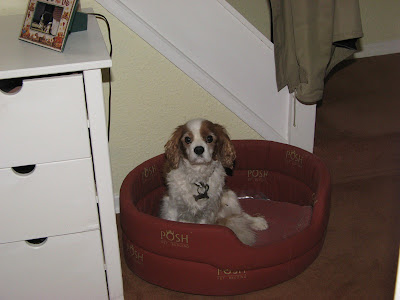
The first image, the most important, of course, is of Harry, Sylvia and Ray's King Charles Spaniel. Sadly, just weeks earlier his companion of fourteen years, Sally, had died.
Sylvia and Sharon
Sylvia, Ray and Harry. Sharon and I are cat people, but even we were not immune to Harry's charms. Sharon says there is a dog in our future, though not a spaniel, since they need more exercise than we, who are still working, can give them. Ray and Harry go out for nearly an hour each morning.
We took the train from Pett's Wood and came out on the Thames Embankment near Borough market.
Sylvia and Sharon contemplating a possible purchase.
I did not know that "the clink" referred to a specific prison.


The following images are of the museum and the recreated Globe theatre. The project was started by an American, the actor Sam Wanamaker, who was driven out of the US during the McCarthy era. (No political comment follows.) (I lie, Americans tend to be idiots on the subject of security, then and now, failing to capture real bad guys and making uncomfortable people of conscience. Sorry)


Our guide for the tour, whose name I do not recall, was brilliant, as have been so many of our tour guides.


I remember only the colloquial name for this millennial bridge, nicknamed the wobbly bridge. When it opened it had to be reinforced. Still, pretty, especially against St. Paul's
A walk down Fleet Street, not just famous but also where Ray once worked before all the newspapers left the area, took us on an unanticipated Dr. Johnson tour.


We took a cab over to the incredibly posh Burlington Arcade. There I met Joanne, Andrea and Karen at Penfriend. They were kind enough to show me a number of exquisite English pens, none of which, sadly, I could afford. The entire area is filled with upmarket (make that posh) shops. Too rich for our blood, so we trekked over to Soho and Chinatown, had dinner and returned to Kent.
But not before I had my picture taken with two of my heroes.
Sunday morning, Sharon showed Sylvia, who is an unabashed Amerophile, the website of The Vermont Country Store.
And then we went for a drive to Greenwich and a stroll before heading back to Sylvia and Ray's. It was the first real spring day. Hooray!!


A final image of the four of us in the Atkinson's garden.
This weekend stands as a highlight of our trip. A public thank you, Sylvia and Ray, for a grand weekend and for your enduring friendship over the years. We will see you again, soon, in a few weeks.

Wednesday, March 18, 2009

South Wales

Last week our excursion with the students took us to South Wales. I included this in the curriculum for two reasons, a) I wanted them to be aware that the UK encompassses, even today, more than one nationality and b) I wanted them to experience the effects of both internal colonisation and the industrial revolution. Hence the first part of the trip to The Big Pit, a coal mining museum created out of a mine. Unfortunately, for safety reasons, they do not allow photography inside the mine, but I did get some images on the surface.

From there we originally had planned to go on to Cardiff where they could experience the culture of Wales but the logistics just would not work out. Instead we saw the ruins of Chepstow Castle, which gave them another sort of experience and was just plain fun to climb around.

Speaking personally, I have a certain fondness for unrestored ruins lightly interpreted as being the ‘real” thing, and a number of students expressed the same sentiment.

A fun and interesting day.

Later today we do womething very different, and go to Portsmouth to see Britain’s naval history.

It probably will not be until this weekend that I get our London weekend with good friends Ray and Sylvia Atkinson up here


Preparing for our descent into what was, until thirty years ago, a working mine.


Jennifer Do and some coal.
We approach Chepstow. Not only was the castle a great piece of history, but everyone had a frolicking good time.
Rosa just loved it there and threatened, along with Rob Huffman, to move in there. We managed to talk her out of it (Rob, too), but it took a compromise for Rosa. Rob came peaceably.Here I thought I had found a hidden chapel, but it turned out to be just another vaulted roof in the basement
Inside the castle proper, Lauren Minkel poses with some friends

We agreed that armour is a great look for her.Less so for me. But you gotta defend what you gotta defend

Justin and Julian, of course, were the first to discover the joys of climbing the ruins. As faculty guide I was concerned, but still had to snap them before doing what climbing I can these days
Even Sharon got into it.From one of my higher points we set up an impromptu group photo. Left to right Chris Laine, Rickie Bolin, Katie Holmes, Justin Yip, Max Moorman, Sarah Michelet, Katie Rouse, Michelle Nguyen, Jennifer Do, Paul Howard, Sarah Christensen, Kristin Carder, Julian Quihuis.
We also, at least those of us into that sort of thing, went nutz with the cameras.


This image emphasises the strategic position of the castle, commanding the river as it does.Rosa agreed to come back home only if we brought along a new friend Goch.
Bob has been our bus driver for a number of the tours, adroitly managing the coach, often on roads not fit for it and putting up with us lot.

Wednesday, March 11, 2009

Cardiff (a few days late)

I’m late in posting our trip to Cardiff last week. It’sthe middle of our term and things are getting a bit exciting, even in paradise.

Sharon and I last visited Wales in 1972 on our first trip abroad after having been married. We were in the northeern part of the country, which has always been more rural and more Celtic. We have never been in the sourh part, Cardiff, Swansea, Newport. I’m guessing we will return in May when our term is over and we have five weeks to tour.

As a result we had no prior expectations of Cardiff, unlike Bristol or Dublin. It’s an interesting city that appears to my eye to have been built almost entirely in the late 19th and/or early 20th Century. I know there must have been a city here before, apart from the castle, but I did not see much of it. My curiosity is whetted to know more.

Our trip began Friday morning with a quick and relatively easy train trip. We managed to navigate our way to the hotel, the Beaufort Guest House on Cathedral Street with relative ease. We were stunned by the hotel itself, much more luxurious than we would have thought for the money. Anyone planning to visit Cardiff would be well advised to stay there.

We needed lunch afterward and were pointed toward a pub, The Conway, which offered us one of the best meals (yeah I know I keep saying that) we have had thus far. Sharon’s fan fried (more a sauté) cod was perfectly cooked and presented as was my ox cheeks with mashed potatoes. Though we should not have done we both indulged in desserts, a warmed Perlwen cheese for her, apple crumble for me. We were told that The Conway offered good pub food. This was much more than that.

Fortunately, our next destination, the National History Museum and St. Fagan’s Castle, was a bit away and the buses infrequent, so we got a bit of a walk before the number 32 bus caught us up.

St. Fagan’s castle, formerly the seat of the Earl of Plymouth, was worth the visit by itself. But the site also houses an outdoor museum made up of traditional buildings moved here. Now as a preservationist (in a previous life), I prefer to see historic buildings in context, but as tourists we were enthralled by the old woolen mill, the Kennixton House (which I inexplicably failed to photograph in all its red glory) and by a number of buildings both native to the site and moved there.

Saturday took us to the Cardiff Castle, a site that traces back to Roman times. The Black Tower was erected during the Norman period, but for the most part the site as it stands today is the work of the 3rd Marquess of Bute, who began working on it before he was 18 years old, and his “pet” architect William Burges and has to be seen to be believed. My comment to Sharon as we toured was “so this is what Hearst was trying to do.” The photos hardly do the thing justice.

The weather was not with us later in the day, so we saw less of the city than we might have, and the same was true on Sunday. I did, however, manage to score three pens, a Parker 17, a black chased celluloid Mentmore button filler, and a later Aurora 88 (a P, I think). Nothing exciting, but a pen fix for the pen freak in me.

Even though Sunday’s weather was not the best, the morning offered us an unanticipated treat, a veteran’s day parade led by the Castle’s Welch Regiment and their goat. The parade was most moving to see not just the regimental band (one of whose tunes was The American Patrol!) but the remaining World War II veterans drilled by their sargeant who observed that they might have formed up more smartly had they not visited the pub beforehand. We thought hey did quite well. The Lady Mayor reviewed them and off they went toward city hall. Our intention was to go down to the harbour, but the weather forced us indoors to the very nice Welsh National Museum with its Welsh and other paintings and a wide range of exhibits and some nice interpretation.

More than enough words here. On to the images:

Sharon at the entrance of St. Fagan's Castle, dating from the late 16th century. The unprepossessing exterior hides a lovely and rather original manor house. Unfortunately they do not allow interior photography of any kind. (And, in truth, they are right not to do so from a preservation standpoint.)


An early tower on the grounds
This is the woolen mill, which, if I recall correctly, is original to the grounds.

A stone, wattle and thatch barn
The recreated village.
This unprepossessing row of five ironworkers' cottages encompasses one of the best pieces of museum interpretation I have ever seen, each of the cottages is presented as they would have been furnished in 1800, 1850, 1900, 1950 and 1985. Just brilliant!
The next day, Saturday, in Cardiff, Sharon and Rosa decided to stop at The Black Pig for a pint. Fortunately they were closed at 9:30 in the morning. Shocking!
The west wall of Cardiff Castle. The Castle and the rest of downtown turned out to be just a short walk through Bute Park, from the Beaufort House. We only used transit buses to enter and depart, everything else was walkable.

The red Welsh dragon at the entry of the Castle.
This is the Norman Castle keep.

The national flag atop the castle.And this the 19th century castle in all its neo-Gothic glory.


Guided tours of the interior are available, well done and most informative. This is the children's room.
Various images from the interior.


Rosa and the 3rd Marquess.
A neo-Gothic spire atop the castle.
After the castle and some touring on the hop-on, hop-off bus, we made our way to Jacob's market, what Americans would call an antiques mall. Jimmy the con man had three good pens for me at a great price.

Back in the day, the railways operated hotels and pubs for travelers, this is the Great Western in Cardiff, made from stone from all over the world that found its way to Cardiff via the harbour as ship's ballast.
Walking back from Jacob's market in off and on rain, we just stumbled across this market. Crdiff's city centre is laced with these indoor arcades housing everything from jewellers to fast food.

The "animal wall" designed by Burges, though built after his death, included a Pelikan among its sometimes fanciful beasts. Of course I had to snap it.
Sunday morning, rainy still, as the Welch Regiment readies itself for the veterans' parade.
The veterans

The goat. And before you e-mail to ask, no I have no idea why a goat.
The Lady Mayor arrives to review.
Thomas Jones' iconic image of the Bard, based on Edward I's slaughter of the Welsh bards, an early attempt to suppress Celtic nationalism.
Sharon's favourite, here photographed badly, a work in metal, wood and gesso by Edward Bourne-Jones, one of the leading pre-Raphaelites.
A final image of Cardiff, the red dragon device on a plinth in front of city hall.

Friday, March 6, 2009

Glastonbury and Wells

This week’s Thursday excursion took us to two very different places, Glastonbury, which traces its roots as a holy place back before the Saxons and before Christ, who in legend visited there, and Wells, England’s smallest city, a modest place with magnificent cathedral.

Glastonbury is a strange place. In legend it was the site of Camelot on the Isle of Avalon the home of King Arthur, Queen Guinevere and the Knights of the Round Table. In reality it was the seat of a powerful Saxon warlord of the same name. It was also, however, an incredibly powerful medieval archdiocese, made so, in part, by the legend even then associated with it.

Its Abbey, destroyed by Henry VIII and then by the Puritans, stands today as awe-inspiring ruins. These images fail to convey the size and the grandeur of the building whose size rivalled Westminster. We were told by our guide, the education director of the organisation that today oversees the site, that the Abbey would have stood one-third taller than seen today.


Bathed in magical light, we begin our tour of Glastonbury.
This image barely begins to give some sense of the size of the abbey.


The Abbott's Kitchen, the only completely original and itact building on the site.Inside the kitchen, an interpreter garbed as a Benedictine monk, explains the benefits of monastic life in the late middle ages, shelter, medical care (such as it was), and food.
Andy Fleck, Barbara Zimbalist and Rickie Bolin listen to an account of 12th century monastic life.

Our intrepid, personal guide, Rosa, here after conferring with some Glastonbury sheep.
Neither Sharon or I thought our aging knees would appreciate the descent, so we did not go up to the famed Glastonbury Tor, seen here through the miracle of modern photography.

A farewell to Glastonbury, a cross between Santa Cruz and Arcata back home, blending new age with hippiness.
Entrance to the cathedral from the medieval town square.
Penniless Porch, the entry to the cathedral, from the town.
Wells Cathedral. What more can one say? It was a lovely, cold early spring day.

Our intrepid group, ready to troupe into Wells Cathedral for our guided tour. The tour guide was incredibly knowledgeable and a fine teacher. I learned a lot. From left to right Max Moorman, Julian Quihuis, Megan Hart, Zac Wagner, Katie Holmes, Sharon Propas, Lauren Minkel, Jenene Castle, paul Howard.
Outside detail from the entrance.
First built in the late 12th century, this early English Gothic cathedral was added to over the next hundred years. By the 13th century, the weight of the new tower began to threaten the structure, so the unique scissors arch at the bottom of the image was added to stabilise.
Architectural details like this delight both eye and lens.
The magnificent 13th century window. Our guide explained that unlike so many this window survived the English reformation simply because it was out of reach of those who would have destroyed it.
The magnificent staircase leading from the cathedral to the Chapter House from where the cathedral was governed.

Looking backward at the entrance of the Cathedral Close.
The Cathedral Close where in early days the officials of the archdiocese would have lived. Today officials of the cathedral and the school share accommodations for living and work space in a stunningly beautiful atmosphere.

Wednesday, March 4, 2009

Coming Soon

Glastonbury, Wells, Lacock Abbey
Cardiff
Stay tuned.