The PENguin Blog


The PENguin's Lament

Confession: I miss the blog. I miss doing stuff and then coming back, analysing, discussing and sharing; and then, on occasion, hearing back from someone about their response.

Don't get me wrong I also miss England, Germany, friends and travel. But I miss the blog.

So, at the risk of posting totally banal, really bloggy -"today my cat caught a bird "- sort of stuff I'm gonna try to post something of interest to someone somewhere each week (more often if possible). It may not always be either travel or pen related but I will try to do it at least once a week and make it as interesting as my humble existence permits. So here goes.

As always, let me know how I'm doing. E-mail works best, but I do check for comments.

Thursday, May 28, 2009

Travel Tidbits, or vignettes from the road.
We are now back from Germany having spent a rather wonderful short week renewing an old friendship and gathering in a last few pretty great pens, as it turned out. All the time enjoying the great weather and fine sights of Nürnberg.

On arriving in England Tuesday, we set off from Heathrow mid-afternoon and got into Bedford in the evening. Wednesday brought us to York, and today, Thursday, we set out to explore the city, which we last visited in the 1970s.

To be honest, for a number of reasons the trip back found me grumpy, but not so much so that I did not enjoy perhaps the best response to pens since the institution of current security procedures, bearing in mind that I fly an average of five or six times a year, often more, with a significant number of pens in my carry-on luggage.

At Schiphol (Amsterdam) you go through security at the gate (often for a second time, if your flight originates elsewhere, as ours did), a really efficient manner of dealing with the problem. So we go through, off comes my belt and I empty my pockets, including the Tighe M800 set that are generally my travel pens, into my backpack. Out comes the laptop, and we go through. At this point one of two things usually happens, either the pens and I go through without comment or the backpack gets searched.

So, I was not too surprised when the head of security came over bearing my bag and asked if the pack was mine. “Yes,” I answered. “I have to make a note," he replied. "Would you happen to have a pen?” My bad mood broken I replied, “I may have.” We both grinned widely and he walked off.

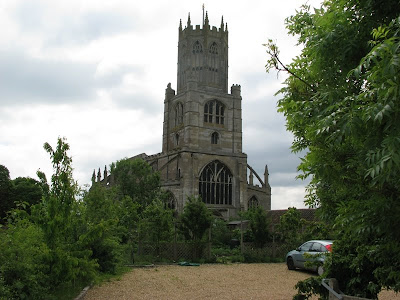
Having stayed the night just beyond London at the Bedford Swan Hotel, we set out Wednesday along back roads headed for York. Along the way we made two stops, one in Fotheringhay village, based on nothing more than a whim, and the other born of my desire to visit Peterborough, the scene of the infamous Peterloo massacre of 1819, the last truly revolutionary moment in modern British history. Well, one for two ain’t bad. We struck out, totally, in Peterborough, a thoroughly modern city that, honestly, we were too fatigued to cope with, but Fotheringhay turned out a treat.

The village is the birthplace of Richard III, a crossroads in the War of the Roses, the site of the execution of Mary Queen of Scots and is little changed since then with its simple early Gothic church.

From there we continued north without stop after the abortive detour to Petersborough. On the way, though, we did notice in one village perhaps the best name for a fish and chips shop we have seen, Frying Nemo.
We got to York mid-afternoon, settled into our B&B, Sharon got some work done and then we headed out for a bit of dinner at a local restaurant the owner of the guest house had mentioned as being good and close. Score!! Melton’s offered us one of the best meals we have had in quite a while. If you are in York, don’t miss it, especially as the prices are quite reasonable for the UK.


Fotheringhay church. A simple late Romanesque/early Gothic parish church the villagers struggle to maintain it. I emptied my change pocket (about £5) and should have left more.


The village.

The farmhouse, understandably, is more modern.
Today, we explore York. Stay tuned.

Tuesday, May 26, 2009

Nürnberg and Franconia

Nürnberg exists within, though it was not historically part of, Franconia.

On Sunday and Monday, Ekke and Gudrun gave us a taste of Franconia when we visited Bad Staffelstein, Lichtenfels, the Convent of Viertzenheiligen and the Kloster (cloister) Banz. Taken all together, these sites make up a major regional cultural and recreation area and are a place that Ekke and Gudrun visit on a weekly basis to take the waters as is common German practice. We accompanied them and in the course of the afternoon got a nice taste of regional history through the two religious sites which featured two lushly baroque/rococo churches as well as the baths.

On Monday Ekke had an appointment in Erlangen, but before going there detoured us to visit Bamberg, a wonderfully intact city that showcases several centuries of southern German architecture and culture. A castle on the site is first mentioned in the early 10th century, though the city rose to prominence with the election of Heinrich II and his queen Kunnigunde to rule Bavaria as part of the Holy Roman Empire in 1007.

On Tuesday, our last day here, we rambled the altstadt of Nürnberg, following the Pegnitz river which bisects the city. Even though Nürnberg was badly bombed in the waning days of World War II, much of its architectural heritage either survives or has been rebuilt, as is often the case in Germany.

Throughout, as is apparent, I had tons of fun with my camera:

The approach to the Vierzehnheiligen (fourteen saints)
This was Sharon's and my first recent taste of the baroque/rococo. Gudrun noted that the style is not to her taste, but that this was a spectacular example. We had to agree.


The valley between the two religious structures. You can just see the twin spires of the fourteen saints convent in the hills. Kloster Banz prohibited photography.

The slopes of Kloster Banz are used on Sundays by hang gliders

On Monday we visited Bamberg


Sharon and Ekke at the entrance of the cathedral in Bamberg.


The Domplatz looks out onto the New Residenz of the city's rulers and a civic rose garden

While the roses were not fully out yet, the garden was lovely and offered some great prospects of the city.


After a brief bus tour, which took us to the altenburg, the old castle, we rambled the streets, headed toward the bahnhof.


These fisherman's houses date back more than two hundred years

We enjoyed a lovely day in Bamberg, surrounded by historic architecture.
On Tuesday, Ekke took us for a through the old city of Nürnberg. With the Pegnitz flowing through the city centre, Nürnberg is a city of bridges, lovely to photograph.

For a few hundred years these buildings have provided public housing


Could not resist taking a picture of this Gogomobil, one of many tiny cars built during Germany's early postwar recovery. The proud owner gave me a thumbs up for my appreciation of his car.
This 1984 fountain depicts relationships. I was drawn to the family in the pelikan, of course.
From here, we embark on the last two stages of this remarkable journey, the English walled city of York, and a final stay with our friends Sylvia and Ray Atkinson outside London.

Sunday, May 24, 2009

Die Blaue Nacht

While discussing plans for the Nürnberg penshow, my friend Gerhard Brandl mentioned the blue night, which has been going on in Nürnberg for ten years now. As it turned out our friends Ekke and Gudrun had never been, so following the pen show all four of us set out with approximately 130,000 others to the old town of Nürnberg to experience this great cultural event that literally lights the city in blue, opens museums and other institutions all night, and this year featured more than 250 installations loosely grouped around the concept of “a canopy of stars” in conjunction with the International Year of Astronomy. If you seek further information (in Deutsch), check the website http://www.blauenacht.nuernberg.de/

So, after a light supper, we headed into town to see what we could see. Well, it was an incredible event, what we back in the ‘60s would have called a “happening,” but throughout the city. We visited a half dozen installations, including one in a disused bomb shelter, stopped for coffee and headed for the Haupt Marketplatz where they were firing three hot air balloons. The crowd there was scary intense, so we headed up the hill to see the castle, but did not quite make it. It was a unique and intense experience, one worth doing.

The following images provide just a small taste:

Left to right Ekke, Gudrun and Sharon inforn of the planets


Saturday, May 23, 2009

Nürnberg (or Nueremberg or Nuerenberg, I’ve seen all three spellings)

In truth, this visit is only to a small degree about the city. We are here, in about equal importance, to renew an old friendship and for me to attend the second Nürnberger Schreibgeräte-Sammlerbörse held at the Ofenwerk, Zentrum für mobile Klassik-Autos on Saturday, May 23.

The other reason for our visit takes Sharon and me back 35 years to the early 1970s when I worked in a reproductive biology lab and became most friendly with a German physician who was training there as a Ford fellow. Despite our different ages and backgrounds we became fast friends but after he returned to Germany in 1974, we lost touch. Long story short, Ekkehard got in touch with me a couple of years ago via the internet and we renewed our friendship. For a time, in fact, it seemed that he and his wife would visit us in the Bay Area, but we got to Nürnberg first.

We arrived Thursday afternoon and Ekke met us at the airport, all of us wondering if we would recognise one another. We spent the rest of the day quietly, a badly needed rest for Sharon and me after the rigours of the past few days.

The next morning Ekke’s wife Gudrun returned from a business trip and we spent another quiet morning, going out after lunch and into the early evening to view the town. From there I went on to the pre-show dinner and Ekke, Gudrun and Sharon headed off to the theatre.

On Saturday, Ekke, who collects books, was curious to experience my addiction and came along with me to the show, staying only briefly. As is so often the case, I managed to get myself in trouble before the show even began when I was offered a pen I never thought to own, a short captop Pelikan 101 in tortoise. After a restless night, I took posession in th morning, excited and thrilled.

As I wandered through the show buying relatively inexpensive pens for the website I ran into another friend, perhaps more addicted to tortoise Pelikans than I am, who purported to have a set that, if real, goes beyond legend, a three piece Pelikan M/K/D 800 set.

“Oh, yeah,” says I. “you happen to have it here?”

“I do” says he.

I expressed the requisite admiration and envy and so the story ended, I thought.

Again to cut to the chase, a half hour later, he offered me the set. There it was, in the space of eighteen hours I had spent a small fortune on a pen and a set I never expected to see.

Thus sated, I was able to relax, enjoy the show, the company of friends, a good schnitzel for lunch and view the cars.

For this show combined major and minor addictions as the site was a complex that restored, displayed and sold classic cars, including German, American and British makes.

So, first Nueremberg and then the show:

My friend Ekkehard Jecht along the river. In truth, the following images are just a tease, as we plan a much more extensive walk of the city for Tuesday.


The show and the cars
Michael Gutberlet, show organiser
BMW 2800CS, designed by Bertone, one of the prettiest BMWs of the era
Tom Westerich talking to Michael with his back to the camera
My first sports car was a Triumph TR3, in nowhere as nice condition as this one
In truth, the show was a bit lightly attended by the public, but the quality of pens and the welcoming atmosphere more than made up, and people there had time to talk to one another and I saw (and participated in) a lot of commerce. From my perspective the show was simply grand. When I am able, I'll attend again.
The shop does ground-up restorations, such as this BMW 2002. My 1970, which I drove for twenty years and 300,000 miles was in red.
Gerhard Brandl
David Parisi
The tortoise 101

The M800s in tortoise
The pencil, heretofore rumoured, but never seen.

Friday, May 22, 2009

Out of Scotland, Slowly

On Sunday we left Edinburgh, headed for Northumberland and (we thought) York.

Now, if someone says England and tourism, your first thoughts do not turn to Newcastle Upon Tyne, which formerly was the county’s largest city, or for that matter to any place in Northumberland. But for many English folk we have talked to, this area is a great treat, as it has become for us.

Jim Marshall first put us onto the area, marking out Alnwick, Holy Island and Bamborough on our maps. We took it from there and spent three days prowling the backroads and coming to love the area, enough so that we delayed our trip to York until after our return from Germany, in order to get a bit more time in that corner of England.

So, what have we seen and done to warrant such enthusiasm?

Our first stop Sunday afternoon was, in truth, still in Scotland, at Preston Mill and Dovecote or as they put it Phantassie Doocot. The mill, which seems to be a locally popular stopping and walking place, was located an easy half mile stroll from the dovecote and provided a lovely break in our morning.

Our next goal was Holy Island with its ancient abbey and Lindisfarne Castle. We drove the causeway to the island, which is cut off at high tide, parked and walked the village and then out to the castle, which despite its ancient lineage turned out to be just another Edwardian pile (we are becoming such castle snobs that anything newer than two hundred and fifty years barely warrants our lofty attention). Still the castle and village made for an amusing stop.

From there we headed for Bamborough and yet another castle. Scotland and in the north taught us one of those interesting practical lessons. We all know about feudalism. Ya don’t have to be a college professor to know about lords, barons and all that. But driving across this part of the UK taught us the truly local nature of feudalism. All this is a gassy way of saying that in both Scotland and the north

From there we pointed our SatNav toward Alnwick. A word, here, on local pronounciation. The river is, of course, the Aln, pronounced as you would expect. The town nearby is Alnmouth, again, prounounced as you would expect. Alnwick is pronounced “annick.” Go figure.

Our first night there was spent at Blackmore’s Hotel which did not meet our needs, but the dinner was very good and the hotel manager was more than fair in compensating us for our inconvenience. From there we transitioned to the Roxboro House B&B in nearby Warkworth. Run by Claire Gibson, it is among the one or two nicest B&B’s we had occasion to stay at. And you could not beat the view from our bedroon window. In fact the place occasioned our decision to stay another night. We spent the day Monday at Alnick Castle and Gardens.

Only as we entered did we realise that this castle was and is the seat of the Percy family who were first projected into English history by Harry Percy, “Hotspur,” celebrated by Shakespeare in Henry IV, Part I. For exactly 700 years the family have inhabited the castle as the Earls and Dukes and Duchesses of Northumberland.

By this time, of course, we have been through more castles than we can recall and have developed a sense of them. We agree that for us the most resonant ones are those which have been in the hands of a single family through time, and, of course, the Northumberlands have played a major role in the history of England.

In contrast to the Spencers, who occupy Blenheim as the Marlboroughs, one does not get a sense of entitlement from the current Northumberlands. This, perhaps, is because the 12th Duke is the younger son and would not have inherited save for the early death of his brother, but the Percys seem to play a major and constructive role in the life of the area.

Recently rebuilt and redesigned by the current Duchess, The Alnwick Gardens are a horticultural fantasyland in which I had some fun playing with flowers.

Like so many of these families, the Percys had multiple holdings in the area and only when we briefly visited Warkworth Castle, outside our window, did we realise that it, too, though now in ruins, once belonged to the Percys.

Preston Mill.
The drying room, for grain

the dovecote

Lindisfarne Castle, built from the wreckage of the 11th century priory following the dissolution of the monastaries in the 1550s, the castle was extensively rebuilt in Edwardian times and includes a Gertrude Jekyll Garden which we did not visit.
Nearby Bamburgh castle.

And here, Roxboro House where we spend two lovely evenings.
The view of Warkworth Castle from our bedroom window.
A photo of us both in front of Alnwick Castle taken by a friendly passerby.
Along the crenellated tower "defenders." One wonders if anyone was really taken in by these non-lifelike figures.
The most famous of the Percys.


The grounds, as designed by Lancelot "Capability" Brown. In the mid-18th century, Brown literally invented the English landscape garden looking out over the grounds at Alnwick one can see why he was called on to landscape so very many of the great houses of England.

The present duchess, who has recently been appointed Lord Lieutenant of Northumberland , began a project to rescue the garden from ruin in 2000.
The grand fountain, recently designed

Some flowers


A poppy

In truth, after Alnwick we were a bit castled-out, but it was our last day in the area and Warkworth was across the street. We had time for a flying visit just as they were closing.


And, of course, I am powerless over ruins.

In order to have the maximum amount of time in Northumberland, we stayed there Tuesday night and then drove 350 miles on Wednesday before leaving Thursday for Nürnberg. Why is it we are so tired?

Tuesday, May 19, 2009

Edinburgh

We arrived in Edinburgh on Thursday afternoon, settled into our bed and breakfast, 23 Mayfield, which was one of the two nicest we have stayed in while in the UK. Our host Ross not only offered me use of his weight training room (I had not worked out in almost two weeks), but suggested The New Bell where we had the first of several excellent meals, for me a woodpigeon starter, followed by some of the best venison I’ve had since Quebec in 2004. Later that evening, I managed to connect with penfriend Azad Sadollah who graciously offered to tour us through the city on Saturday.

After a good night’s sleep first thing Friday we jumped onto a hop-on hop-off tour through the central city. Our host suggested the green buses, as they had live narration. The only drawback here is when, as happened to us in Oxford, you get an underprepared narrator. The guide for Edinburgh was just fine and gave us a nice overview of the central old and new cities. After touring and identifying points of interest, we departed the tour and spent most of the rest of the day exploring the Royal Mile. One of the tips we picked up on the bus tour is to explore the closes or wynds, those little alleyways off the main streets.

Up ay the top of the street, near the castle, the street was very touristy, lined with souvenir shops offering merchandise of dubious quality and cashmeres and woolens (some of them Scottish) of varying quality. On the second day of our visit to Cumbria with Jim and Jane Marshall, Jane took us to the Woolen Mill, a women’s cooperative that sold both exquisite yarns and finished products. There, among other things Sharon bought a hand knit sweater, but they had none in my size. Having left our heavy woolens in London under the mistaken assumption that spring meant warmer temperatures, Sharon let herself be talked into the purchase. I was jealous. Cold weather in St. Andrews led me to purchase a Johnston’s lambswool jumper, not a hand knit, but it kept me warm, but, thinking Friday would be warm (stupid or what?) I left it home. After some searching we found a shop offering cashmere Pringles’ seconds at attractive prices. Each of us scored.

But shopping was not the main focus, just down from the castle was Gladstone’s Land, a Scottish Trust property. Our National Trust tickets got us into a museum that depicted the growth of one of Europe’s most densely populated cities in the 16th and 17th centuries, during which time tenements built of stone and timber and supported by the hillsides, rose to as many as 12 stories. Home to both the wealthy and the poor and built cheek-by-jowl, the conditions, even for the well-to-do who occupied the middle stories, must have been appalling.

We wandered on, had a lovely Italian lunch, spaghetti carbonara for me and for Sharon a fruitti di mare calzone the size of Edinburgh, and made our way down the Royal Mile toward the Holy Rood. On the way we stopped at another museum (if I am powerless over ruins, Sharon is powerless over museums), one dealing with Edinburgh life. Between that and the Land, we got a nice vignette of the life of the city in the past and more recently.

Then came Canongate crafts. As we passed the shop, my comment was that this was the place we should have gone to start with. It was a bright blue storefront run by a woman who both knit and commissioned and sold knits and yarns from friends. After chatting with the owner, who had been there for twenty five years, and trying on several possible purchases I found the perfect hand knit and Sharon managed to get our last family gift, a necklace for our niece.

A combined bus ride and walk got us back to our B&B despite a pretty heavy downpour which left all our outer clothing pretty drenched. Still, a good day, but with more to come.

Saturday dawned with better looking weather than anticipated. So around 10:00 we left to go downtown to meet Azad. We were early and so walked over the South Bridge across to Princes Street and the Scott Monument and then met up with him for a seven hour stroll across the side streets, by-ways and museums of the city, finishing with a walk along the Leith River and past Deans Mill. On the way we stopped back at Azad’s flat for tea and some pen show-and-tell. Azad’s collection is quite formidable for both quality and breadth, and a curious little Pelikan, built like a post World War II Ibis but marked Pelikan Junior, came into my hands. Dinner was at the Red Fort and unfortunately by then it was past 9:00 and Sharon had faded, so we had to pass on an evening of Iraqi music. It was a lovely day and a short cab ride brought us back to our B&B.

Our first view of the old city and the south bridge.


The approach to the castle at the head of the Royal MileHere, tucked between two of the typical (and often hideous) tourist shops along the mile, was one of the most fascinating house museums we have seen, the Gladstone Land. Sadly we could not photograph inside.Scenes along the mile
Like most cities, to fully appreciate Edinburgh you must look up.


Canongate Crafts, the cooperative where I got my very own hand knit sweater. Apart from the desire for a hand knit, it was most a most comfy find in the rather challenging weather Edinburgh had on offer that weekend.
Part of the joy of the mile were the closes, or wynds, that led off the street
Nineteenth and early twentieth century working men's banners fighting for the vote and other basic rights on display in the museum at Canonsgate that presented life and work in Edinburgh
Couldn't resist shooting these advertising plaques

Sheltering from the blustery weather.
The city's most prominent monument, to Walter Scott.

David Livingstone, (think H.M. Stanley and "Livingstone, I presume") who the Scottish historian Niall Ferguson regards as "the Victorian Superman," a leader in the effort to bring morality to the British Empire and Christinity to Africa.
After a bit of a wander and a gaze at Scott and Livingstone, we met up with Azad for a wonderful walking tour that would take us to places we'd not otherwise have seen.

Azad and me at the entry gate of Edinburgh University, where he studied Law and then did articles in private practice to become a solicitor (Americans, think lawyer).
At the museum of Scottish technology.
We had to visit Greyfriars, of course,
the cemetery also offers some grand views of the city above

A particularly gruesome memento mori

The foot of the Royal Mile.


Monument in the park below the castle.
A crescent very different from those we were used to in Bath.
The Presbyterian hand
The side wall of one of the mills in the Dean's Mill area, Leithside. This is now an area of gentrified housing. From here we took a lovely walk along the river back toward the main city.

Until recently a school for disabled youth, this impressive building now houses Edinburgh's modern art museum. Sadly we spent too much time walking and on pens to see the collection.
From here, a short walk took us back to the city, to dinner at The Red Fort where we had a fine Indian meal. By this time, Sharon and I, tired from a day of sightseeing, took a cab back to our B&B and Azad went on to a concert. Thanks, Azad, for taking the time and being a fine host in your city.

Sunday morning, we headed south.

Friday, May 15, 2009

Scotland, part I

Leaving Cumbria Monday morning and following a route Jim had traced for us, we set out on a sunny morning for Scotland making our way up through Glasgow and headed for Troon.

Along the way we stopped in, briefly, at Gretna and Gretna Green, famous since the 18th century as a place of elopement for couples who could not, for various reasons, marry in England. It was horrible. The marriage houses, as they are called, are still there, but have been converted to tourist traps of the worst sort. I’ll spare you the details. But it made Reno look like a garden spot.

Partly because of the narrowness of the roads, we did not stop to take a lot of photographs along the way, but the scenery was quite grand.

Throughout this trip, Sharon still must work her twenty (often more) hours a week, so our sine qua non for lodgings is internet access, not so easy to find in remote areas, it turned out, but we lucked into the Pierpont House Hotel in Troon, especially so as the place is a golfing centre and we happened into some sort of run up for the event. The hotel was built as a home by Alexander Walker, heir to the Johnnie Walker fortune. The hotel was lovely and dinner was quite good.

From Troon, we struck out for Loch Lomond and the Highlands. I’ll let that scenery speak for itself.

We ended the second day in Fort William at a lovely little guest house, the Ardgowan Guest House. Fort William is the jumping off place for those who both walk the highlands and scale Ben Nevis. It seemed like everyone at the hotel was disgustingly fit and ready to take on the UK’s largest mountain. One fellow I spoke to was in the second year of an effort to walk from Land’s End to John o Groats, that is from one end of Great Britain to the other.

We toyed with the idea of heading from Fort William to Inverness, which would have added a day to our time in the Highlands, but would also have taken Edinburgh or York off the itinerary, so decided from Pitlochry to head to St. Andrews via a route that I could not retrace the next morning. Throughout this stage of the trip, we have more or less followed an itinerary laid out by Jim Marshall earlier this week and I must say that the scenery has been superb. The only real disappointment has been Pitlochry, which was rather touristy.

From Pitlochry, we continued, without very many photo stops, to St. Andrews.

St. Andrews is known for two things, golf, of course, and the university. Unlike Jim, we have no interest in golf, but the it has been fun to see another British university. Even moreso, we enjoyed seeing the city, the castle and to get a taste of the bloody history of the Scottish Reformation which seems to have started here. We spent most of Thursday there before taking the short drive to Edinburgh.


While we were with Jim and Jane, Jim complained about the rampant spread of gorse, but it is pretty stuff. But as we toured we came to see his point. It's everywhere, including all around Edinburgh.
Our first Scottish ruins (wait, there will be more). Honestly, neither Sharon nor I can identify this abbey, except that it is dedicated to some saint and is a Scottish Trust property.


This we can identify, Loch Lomond
From there we went into some spectacularly desolate highland moors


A cairn, with no identification in the middle of nowhere.


This is, I think, Loch Rannoch. Part of the problem is that we are tired and are probably moving too quickly, but also we have been wandering, letting fancy lead us and only when lost switching back on the SatNav.


Sharon wanted a picture of some highland ponies.

St. Andrews would not have been on our list, but the town turned out to be delightful, not for the golf, which we have no interest in, but for the university and the ruins(!) of the castle and cathedral.If this is to be believed, W. Malcolm carved his name in 1798. Students commonly did this.


Could not resist this street scene
The castle. St Andrews was the ancient centre of Scottish Catholicism and was the site of some of the bloodiest chapters of the Scottish Reformation


Your humble blogger
At one point, the castle came under seige, and the attackers dug mines to try to take it. Frantically the defenders dug countermines and here they met.


The abbey and cathedral


After the dissolution and destruction of the abbey, townspeople simply used the grounds for burials.


What is charming is the way that students use the walls of the ruined cathedral as outdoor carrels for study and lounging.
From St Andrews, on Thursday we made a relatively easy two hour drive to Edinburgh

Monday, May 11, 2009

Cumbria, Lakes and Friends (not in that order)

Friday afternoon, we fetched up, with some final guidance, on Jane and Jim’s doorstep in Cumbria

After a bit of rest, a nice chat and a quick load of laundry, we set off on a late afternoon tour of the area, taking advantage of the fact that already it remains light well past 8:00 in the evening. Years ago, in our youth, Sharon and I actually did see the Lake District, but not as Jim has shown it to us.

Our route on Friday took us from Skelton to Keswick and the stunning Derwent Water, to Castlerigg and its stone circle, to Cockermouth, down to Buttermere and then over the mountains to Allonby, Jim’s birthplace, along the Irish Channel to Solway Firth and back through Wigton. Along the way we enjoyed some fantastic scenery, fine company and conversation, and another good meal at the Oddfellows Pub. My bacon chops (think of smoked pork chops) with a Stilton sauce were superb. We ended up back at Skelton for a late cup of tea, more conversation and a lovely night’s sleep.

Saturday took us back out, this time among the Lakes. We had thought to go to Hadrian’s Wall, but the weather was a bit wild for it. We started at the Wool Inn, where Sharon bought herself a locally crafted sweater, some socks and I got myself a tie, as well as some nice photos. From there we went to Brampton then back to Cockermouth, the Wordsworth House and then for a stroll through the town. From there, we traced more backroads, ending up in Keswick, too late for the market, but not for a bit of a stroll and from there to another of the lakes, Ullswater, where we strolled, Jim and I cameras in hand.

Sunday dawned fair with the weather steadily improving, so we set out to do what we had sought for Saturday, Hadrian’s Wall, followed by a visit to Vindolanda, a Roman fort where the Vindolanda writing tablets were unearthed beginning in 1973. The whole story on this extraordinary effort can be found here, http://www.vindolanda.com/planning_a_visit.html.
Before visiting the Marshalls, I must admit that I had never heard of Vinodolanda, but I strongly suggest that anyone visiting the wall visit this site as well.

By mid-day, however, we were “Romaned-out” as Sharon put it and set out to fulfill the next of Jim’s goals for the day, to drive some roads he had not yet driven. As it turns out Jim and Jane love to tour as we do, creatively getting lost on backroads, the smaller the better. We had a lovely afternoon with a stop in Alston, a center for those who trek the Pennines, another fine dinner (a venison stir-fry for me) at the Boot and Shoe in Greystoke, and a final stop at Hartside, a nearly 2000 foot vista point which overlooks the entire area with a range from the Solway Firth up to Scotland.

From there, we headed home to indulge in some serious pen play which resulted in a wonderful red mottled hard rubber Onoto crawling into my hands, followed by a rmhr Relief. Jim’s workshop and gallery defies description. Suffice it to say that it is a wonderful omnium gatherum of pens, parts, tools, ephemera, realia and much, much more. Standing beside Jim at his bench, just casually, I learned more in a couple of hours than I would in an ordinary week working on my own.

As a result of the wonderful hospitality of the Marshalls, we ended up staying in their 18th century home a day longer than anticipated and enjoyed every moment.

This visit highlights for us an unanticipated joy of this trip, visiting friends and the time spent with them.

Jane and Jim's house.


The stones at Castlerigg
Jane and Sharon
Sharon pondering the memorial to John Ruskin near the Derwent Water

The lake
Wordsworth's home in Cockermouth.
These were shot at Ullswater, I think. The lakes and their beauty seem to flow together, so to speak


Jim at Ullswater.


Sharon and Jane in front of the wall


Jim atop the wall


Me scouting for Celts as Jim sits unconcerned


This was at Vindolanda, a private site where Roman writing tablets, and much more, has been unearthed. It's not just the site and the digs, but also a museum that displays an incredible array of Roman objects, both familiar and unique.

Alston, for a cup of tea, some pottery and a walk about


From here, we are off through Scotland along a route that Jim has traced for us.

Friday, May 8, 2009

To the North

From suburban London we headed north, our destination Scotland, but on the way had several stops. On Ray’s advice we headed for Buxton using back roads. Our SatNav system was unhappy, but we managed to get ourselves there.

Our vehicle for this part of the trip is a Kia cee’d, a largish diesel powered hatchback. We rented from Alamo/National/Europcar, largely because they offered the cheapest internet rates. You get what you pay for and when I arrived on Saturday to pick up the car, not only did they not have a Global Positioning System for us, but the car was not at all what we had reserved. They promised me they would get us a GPS from Bristol and swap out the Kia for something more acceptable. We finally had to go to Bristol to get the Sat Nav and another car. They did have the unit, but long story shortwe still have the wretched car notwithstanding three attempts to swap it. They are to be avoided at any cost.

Buxton is another spa town, like Bath, but one which has not sustained its prosperity. They came to prominence, like Bath, in the Georgian era, grew through the mid 19th century, but faded by the early 20th century and are struggling to come back. Nonetheless, as you can see the crescent is lovely as are the gardens.

From Buxton, we headed to Hardwick Hall, built by Elizabeth, Countess of Shrewsbury who, through her own efforts and four strategic marriages, rose to become the second wealthiest woman in England in the reign of Elizabeth I. The houses and grounds are comprised of the Old Hall, in ruins and the New Hall.

From Hardwick, we took the motorway to Durham to visit Clemence Schulze, who teaches at the University there and is a fellow Charlotte Mary Yongian with Sharon. In fact Clemence is the secretary of the orgnaisation.

The next day, Thursday, we toured the town, stunned by the beauty of the Cathedral which dates back to Norman times and is the burial place of the Saxon saint, Cuthbert as well as Bede. Sadly, the cathedral does not allow interior photography. For those who are interested the cathedral can be seen at http://www.durhamcathedral.co.uk/. One is aware of the great cathedrals of Christendom--Cologne, Notre Dame, Milan, and in the UK Salisbury, Wells, and St. Paul’s in London. Durham is less well known, at least outside England, but ranks right up there with the most magnificent of them. The Castle was closed to the public. We toured it late Thursday afternoon, but without camera, and dined in college with Clemence.

The highlight of our brief visit came in the late afternoon, when we returned to Clemence’s, quickly changing for dinner. As we were to be presented to the master of the University and were dining at high table, a tie and coat was required for me (fortunately I had anticipated this in my packing).

To start off with, Clemence gave us a quick tour of the Castle, which now houses the University College. Through the middle ages, Durham was an immensely wealthy and powerful see, ruled over by the Prince Bishop, who held both secular and ecclesiastical power. In the 1830s, as part of the reform, he gave the castle to establish the university, which is the thrid oldest in the realm. After Choral Evensong in the college chapel, we filed into the great hall where the undergarduates of the college were already seated. Following dinner the undergraduates all stood, one of their number came to the head of the room, bowed to faculty and visitors and were dismissed. Only then were we served our pudding, and afterward retired for drinks and conversation to the Senior Common Room.

The evening ended back at Clemence’s home where we got to know a visiting fellow of the college who is here from the University of Saskatchewan studying early 19th century British women writers and another friend of Clemence’s , a physician doing public health research in psychiatry in the National Health Service facility attached to the university. Giles, it turns out, is an extremely talented photographer who kindly showed us a collection of his recent photography, which might be titled “Reflections of Venice,” using the reflection of buildings in the canals there to create striking and often fantastical images of that city.

From here, we press on to Cumbria and Penrith, to see pen buddies Jane and Jim Marshall.

In Buxton, we stayed at a lovely B&B, the name of which right now escapes me, and had a lovely dinner at the Old Hall Hotel

The Pavilion and Gardens were designed in 1871 by Edward Milner, a pupil of Joseph Paxton, who designed the Crystal Palace.


The baths, adjacent to the crescent


Sharon was a good sport on this one, part of our continuing theme. For some reason this trip has driven home the fact that we are no longer young. Maybe it was the influence of our students and our colleagues, so much younger on this trip than we are. Maybe it was the long cold winter. For my part, I have worked to shed about 20 lbs during the trip and am resolved to lose the rest over the next year. Enough.

From here it was off to hardwick Hall, the home of Elizabeth of Hardwick, Countess of Shrewsbury. If the Boleyn family suffered at the hands of the Tudors, Elizabeth's family did not.
Again, and understandably, no interior photography. But as much as any great home, Hardwick gave us a sense of the lives of the wealthy and nobility during the the Elizabethan era. There was a real sense of place, people, time here.
Hardwick Hall is actually two structures, the Old Hall which was partially torn down to provide materials for the family's "true" seat nearby, Chatsworth, and the NewHall. In common with several of my students, I discovered on this trip my inordinate fondness for ruins. Unlike them, I can no longer climb them, but I can photograph them.


From Hardwick, a two hour ramble through backroads took us to Durham. Apart from the religious see, the town emerged in the early 19th century as part of the northern mining district. Clemence's house, the brick fronted row house below, began is an unspecified factory in the early 19th century, was converted to miners' houses and then gentrified in the early 20th century.
The city itself, having grown out of the duchy and the bishopric, sits on a raised, defensible, peninsula surrounded by the River Wear.

The central square, bounded by cathedral and castle, is stunning.
I ended up with no really worthy shots of the cathedral
I did better with the castle exterior
The view from the cathedral cloisters


And beyond the cathedral and castle, the town and its square
And around the city, this lovely riverwalk, of which we traversed only a small part.

After Bath

After we got our students, actually about half of them, loaded onto the coach to Heathrow, on Sunday, May 3, Sharon and I cleaned up th flat and left for London about 10:00. We stopped for lunch in Windsor, outside London. The city is famous, of course, for the royal castle, but apart from that is a fairly ordinary upscale town. We looked at the castle, but did not visit, and could not resist having a sandwich at the crooked house café and were then off to visit Sylvia and Ray.

On Monday, we joined the throngs celebrating the May Bank Holiday at Hever Castle, home of the Bullen family, once wealthy and powerful until their younger daughter Anne (Boleyn) married Henry VIII. Not only did he kill her just three years after marrying her, but her brother as well and the family was ruined. The castle went through successive owners, and by the 19th century was itself in ruins. Just after the turn of the century it was bought by John Jacob Astor who renovated it and turned it into his family home, in whose hands it remains today.

We hit Windsor Sunday afternoon, in the midst of the Spring Bank Holiday Crowds. We did not queue up to the the castle, but had a ramble about town and a bit of lunch.


This, today, is the market, but we were both proud of ourselves for recognising it as a railway station, before even seeing the GWR (Great Western Railway) medallions

As a cabdriver, the Monday Bank Holiday was not a day off for Ray, but heartlessly we set off to be tourists at Hever.


For our sins, it rained. Sharon and Sylvia huddled beneath Sharon's umbrella while I played with the camera. No inside photography was allowed, but I had some fun whilst waiting on line.


Monday, May 4, 2009

Parting Shots

Saturday we went, for the last time, to the Farmers market and got some nice fresh stuff for dinner. We’d talked about going out, but I wanted something from the market.

After dinner we took a last stroll through the city, camera in hand.

Although a World Heritage City, Bath continues to build and renovate the new railway station is nearly complete as is the Southgate Shopping complex
Abbey Gate

Pulteney Bridge and the weir
Looking up Pulteney Street
Some random street scenes


We were able to see a couple of productions at the Theatre Royal complex, shown here
Of course, the Abbey. One of the great joys of the stay was to be able to look out on its tower from our lounge. This is the joy of Bath stone, what it does with the light.
Our flat from across the Avon. We were on the third floor, at the bottom of the protruding bay window. We coull look down on the river.

I have already let one of my colleagues know that we would be interested in leading the three week program to Bath in summer 2011. So it may not be farewell so much as au revoir, Bath.

Sunday, May 3, 2009

A Farewell

On Friday, May 1 we held our farewell event for the Bath 2009 Study Abroad program. Arranged by Mari Brookes, who has been wonderful as our English administrator, in formal setting of the Pump Room of the Roman Baths, it was a lovely and emotionally packed evening. Many of us got dressed up, and we began with sparkling wine and beverages from the bar. Dinner was a buffet, featuring chicken breasts, a lovely fish pie, potatoes and veg, a goat cheese tart and salad. There was bread, wine and bottled water on the tables and everything was fresh, tasty and of the best quality.

My colleague Andy Fleck and his wife Barbara put together a great pair of slide shows covering both the sites we’ve seen and the memorable moments we shared. Then Andy and I presented certiifcates to everyone and special commendations for those who will graduate. Finally, we awarded the doorprises, a Diplomat pen I had gotten at the Northern show a week before, and a ride to the coach on Sunday.

When first we promoted the program to students beginning in the fall of 2008, we promised them a life-transforming experience. As of this writing I have not yet read their culminating essays, but I know that for many of them, the semester met and exceeded those expectations.

What I little realised was that the experience would be so transformative for me. I now view things and react to events around me differently than I did six months ago and, as I wrote to the students on Saturday, before our departure:

Just this morning Sharon was noting what a lovely bunch of people you all are and how hono(u)red we have been to know you.

For myself, I just want to tell you all that you have, each and everyone, contributed to the best semester of my long teaching career.

You guys are great, it has been wonderful, and I hope to see everyone at our barbecue scheduled tentatively for the first weekend in August.

Be well, have fun, travel safely.

At this writing, on Monday morning outside London, about half our students are safely home, the remainder are travelling, as we will be for another five weeks.

This truly has been the trip of a lifetime and the adventure continues. Stay tuned. But, first, enjoy with us a most memorable evening.

Andy sets up the powerpoint projector (as the Brits call it) for the slide show later
The room where we ate was a long gallery overlooking the Roman baths themselves
Sarah Christensen, Katie Holmes, Lindsey Huffman( back to us), Bailee Choy, Rob Huffman, Jennifer Do, Megan Hart, and behind her Kristen Carder, Michelle Nguyen, Katie Rouse.
Sarah Michelet, Alyssa Solano, Rickie Bolin, Max Moorman
Aleks Eydelman, Henry Sumpter, Lauren Minkel and Angela Mendoza

Rob Huffman andAshley Longobardy

Me and Mari Brookes, our wonderful and often long-suffering English administrator. Throughout the semester, Mari was the glue that held us together, making arrangements and making sure that everything was in place when and where needed. Well done, Mari!
Jenene Castle and two Katies.
Kristen gets her certificate


Oscar Brookes, Mari's son and right-hand man.
Andy and I explain it all one last time. We made a great team!

It was a great semester and I wish to thank my colleagues Andy Fleck and Mari Brookes, as well as all our students. As their certificates attested,

The Northern Pen Show

Although my focus is German pens and my first European pen show was the Munich in 2005, I have been looking forward to a pen show in England, specifically the Northern pen show, in Lytham, on the Irish sea just outside Blackpool.

I was not disappointed. Although the Friday afternoon drive up the M6 reminded me of leaving the Bay Area on Interstate 80 out of the Bay Area on a holiday weekend, once I arrived show organiser Alan Lloyd gave me a warm welcome. The next morning, early, I connected up with him and his wife Brenda, and Jane and Jim Marshall. Jim and I checked out the local antiques show before anyone else could get there, and then spent the better part of the day at the Garrards auction in Lytham. Ironically, one of my major purchases was an American Parker 51 blue diamond double jewel in buckskin. Little did I know it was a portent.

The show itself took place on Sunday at the Clifton Arms Hotel, a wonderful old English seaside resort hotel, and was, as advertised, friendly and warm. I was able to meet up with not just the Lloyds and Marshalls, but to see Sarj and Yas Minhas and to pick up from Sarj not just the spectacular blue oversize Carters that we had earlier transacted, but a verde rosso Tibladi 60 pencil (if only I can now find the pen!). I was pleased, aw well, to see Gary and Myrna Lehrer who were missed in Cologne by me and everyone else. I also met someone who had been a pen friend, Azad Sadollah of Edinburgh, and we got in some time together chatting pens and solving the problems of the world. I also was able to catch up again with David Parisi, of Hamburg, who I had seen just weeks earler.

My major purchase of the day was a trio of, you guessed it, Parker 51 blue diamond double jewel sets in buckskin, cordovan and Nassau. The Nassau set, a last year 1948 with an English oblique nib has shared pocket time with the Carter’s from Sarj and my own Pelikan 75th Anniversary since.

This was a wonderful show and I am now looking forward to the Nuremberg show in late May.

Jane and Jim Marshall
Gary Lehrer, David Parisi and Azad Sadollah

Yas and Sarj
David, from across a crowded room.
Mike Selway and Steve Hull
Once again, this was a great experience and I wish to thank all those involved for a warm welcome. As my governator might say, I'll be back.

Saturday, May 2, 2009

Cheezit!!

One day in class, we were talking about things we missed from home and I casually mentioned that I had before me a couple of road trips, to Blenheim and Oxford and to the Northern Pen Show and missed the ultimate road food. Rob agreed, and to show it whipped out a package that he had sent from home. Starting with the next two trips, Rob presented me with a package. Thanks, Rob! They were properly savoured!

Stratford Upon Avon

At the beginning of our tour of Stratford, our guide, Helen, who was a cheerfully relentless promoter of the town, admitted that had William Shakespeare not been born here in 1564, Stratford would have remained little more than another market town. But he was, and Stratford is a major tourist destination. For us it was the last of our excursions for this semester. My colleague, Andy Fleck, is a Shakespearian scholar and he and Mari Brookes, our arrangements guru, made sure that not only did we see the city, an RSC production (As You Like It, one of my favourites), and Mary Arden’s farm, but Andy arranged attendance at some special birthday events on Saturday. Sadly, we missed those, as I was headed up to Lancashire to the Northern Pen Show and Sharon had to prepare for a business trip to Bournemouth the following week.Our tour guide was helen, who gave us a wonderfully thorough walk and talk of the city.


We paused before the Shakespeare birthplace for one last group shot. By this time everyone was acutely conscious that our time here, which seems to have flown past, was coming to an end.

One of the great games of Stratford is figuring out which buildings date from when. Not all half-timbering is equal. Some is new, some old, some has been covered (arrrgh) with stucco.


Holy Trinity Church, Shakespeare's resting place
Buried in the chancel at a time when such places near the alter were highly desireable, Shakespeare wanted to be sure of his place in heaven, if not on earth, thus penning the famous curse:
Good frend for Iesvs sake forbeare,
To digg the dvst encloased heare.
Blest be ye man yt spares thes stones,
And cvrst be he yt moves my bones.

Couldn't resist having Chris take this shot of us.
Friday night saw us all at the Royal Skakespeare Company production of As You Like It. The next day Rob got to achieve a long sought after goal, one that had eluded him in the fields of Avebury, a sheep.


The Palmer house, occupied through much of the twentieth century, is interpreted to the late 19th.

A friendly guide invited us to climb the stairs and view the unrestored first floor (second story to Americans).
The farm interprets 16th century agriculture, including falconry. I did not know that owls could be trained for it, as well.
Katie Holmes and friend
When we arrived in February one of the things I noticed was the lack of classic English cars, in both 1972 and 1980 I had marvelled at the classics in daily use. With better weather I've seen many more, including a couple of Mirris Minors that regularly drive past our flat. This, a vintage Jaguar (I think) .
Rosa enjoyed the Shakespeare weekend, as well. Here posed with a statue of Hamlet that I think of as Hamlet and Piglet.
From here, I took off north for the Northern pen show and Sharon rode back to Bath with some of our students. Others remained with Andy and Barbara and Mari and Oscar for the Shakespeare birthday festivities.

Friday, May 1, 2009

Oxford, Part Two

After Stonehenge and Avebury, Sharon and I took ourselves off to Oxford for the weekend. This was our second trip there and the purpose was for Sharon to attend the spring meeting of the Charlotte Mary Yonge Fellowship. I’ll not go into the history of CMY, but to note that she was a devoted follower of John Keble, who along with John Henry Newman, were founders of the Oxford Movement, which sought to move the Anglican Church toward Rome, not to put too fine a point on it.

Whilst Sharon hobnobbed with her fellow Yongians, I was able to enjoy a day’s ramble on my own through Oxford, roaming the streets, seeking (successfully) pens, and having a fine time.

That evening we joined the head of the Fellowship, Clemence Schultze, her husband Martin and Barbara Dennis for dinner and the next day had a bit of a tour of Oxford together and then headed back to Bath for our final two weeks there.

Since this is written a couple of weeks after the fact and some of the views have blurred in my mind, I shall not try to fully recreate my ramblings through captions, lest I mislabel buildings and bring down upon myself the wrath of those of you who know Oxford better than I.
Sharon (eyes wide shut) in front of the West Oxford Community Centre. From there I went on my ramble of the town, starting with the Oxford Castle, which has been converted into a hotel and shopping complex. Here the castle and the Saxon tower. It's funny how one gets used here to stuff built even in the 12th century, but the pre-Norman stuff brings me, at least, to a halt.
Look carefully at the shop window between the umbrellas for a surprise. I dont like them at home, so why bother here.
The entrance to Cornmarket Street on a Saturday morning. This corner, with Carfax Tower, is the heart of Oxford. From there I headed up High Street. You'll see why in a moment.

As in so many old English towns, one needs to pause and glance down the side streets, or better, follow them.

The colleges are variously open to the public, so what you get to see depends on the day. University college was closed that day, though prospective students are always welcomed.


My destination was here, Pens Plus, though I actually scored two modestly cool pens, a Relief Esterbrook and a gold filled Swan Leverless, before even visiting the Losatos at Pens Plus, where a lovely hard rubber Swan oversize became mine. I guess it is obvious that there would be lots of pens in Oxford, although I gather that there are several members of college in town who collect. Thankfully they left something for me. Nic Losito, who was a student of the legendary Arthur Twyddle, and I had a nice chat about the perils and pleasures of vintage pen restoration. Although the shop by needs, sells new pens, they give over a corned to a nice selection of vintage. For pen lovers the shop is definitely worth a stop when in Oxford.

Pens in hand, I continued my ramble of Oxford. When we were there back in March, we'd not had a lot of free time, so I really did ramble. A stroll through the extensive grounds of the Bodlean Library was essential. The library formerly was housed by discipline, here history.
The next day the hop-on hop-off tour guide would actually tell tourists, us included, that there was some question whether or not this was a copy of the bridge in Venice. Yeah, sure.
Balliol was open this fine day, so for the price of £1 I had a nice stroll through the grounds. This self tour was nowhere near as extensive as what our English guide Mari had arranged for us at Christ Church, but was a pleasant interlude.

Back to the Saxon tower and then through Cornmarket
Oxford even has superior buskers, this fellow most notably.
The next day Sharon and I set out on another walk through the town combined with a hop on hop off tour. At the Radcliffe Camera we happened upon a small gathering if vintage Jaguars and their owners. The cars were all immaculate, but the one that most took my fancy was this XK140 outfitted for road racing. I could just imagine it screaming through the hills of northern Italy at the Mille Miglia, perhaps in the hands of the legendary Stirling Moss.

We ended up our day at the University Church of St. Mary the Virgin. I honestly had no idea of the historical significance of the church. Here, in the 1550s, the Oxford martyrs, the the bishops Hugh Latimer and Nicholas Ridley and the Archbishop Thomas Cranmer were tried and burnt for heresy. John Wesley, founder of Methodism preached here, and Keble and Newman launched the Oxford Movement from this very pulpit in the 1830s

That was it for the day, and on Sunday we headed home. Sometime, I hope to be able to edit and publish more of Oxford.

Catching Up--Blenheim

With term end, I am finally catching up.

Next Oxford, then Stratford Upon Avon and then our Farewell event. Gonna try to do this in the next couple of days.

Everyone knows something about Blenheim, if only that it is one of Englend’s great stately homes, or that it is the seat of the Dukes of Marlborough--home of the Churchills and the Spencers, that it was a base of British government in the darkest hours at the start of World War II, that it headquartered the top secret British intelligence branch MI5, etc. None of that prepares you for what you will see when you approach the palace along the long walk from the car park to the first, gilded palace gates.

Maybe the best way to describe it is as the opposite of an onion, each layer is greater, grander, sweeter than the last, until, having passed through two sets gates and through one modest courtyard, you emerge into a vista that takes away your breath, leaving you open mouthed with wonder.

This is Blenheim. We saw it Friday, April 17, and rather than try to describe it, and fail miserably, I shall let the place and the images speak for themselves, apart from a bit of description.

A couple of notes however. For purposes of security and conservation, in that order, there is no photography inside the palace—understandable, but a great shame; and, despite the fact that we spent five hours there, we saw only a small portion of what the site has to offer--the state rooms and the private apartments and only a small part of the gardens. We did not see the broader grounds, nor the exhibits. A visitor wanting to experience a significant portion of Blenheim would be well advised to budget two longish days for the visit.

Rather than trying to give you the history of the house, I will refer you to the palace website, which really reflects the tone and style of the place. Go to http://www.blenheimpalace.com/. It actually is worth the visit.

So here we go:
The approach, grand though it be, hardly prepares you for the treasures that lie within


There is no interior photography, as I noted, so after the tours of the state apartments and the private apartments, we wandered the gardens on a gray spring day.
Consuelo, Ninth Duchess of Marlborough, is not a family favourite. The marriage to Charles was not a happy one. But she brought the Vanderbilt money to Blenheim, and is here commemorated as a Sphinx.


Rosa, our constant companion, here comforts a dying Gaul